 Ledger
Answer-first verdict · 4.3/5 (provisional)
Trizeflow for freelancers is the most convincing irregular-income pitch we have seen this year. The pitch is one connected money dashboard rather than another single-purpose tracker: budgets shaped around uneven paydays instead of fighting them, forecasting paired with subscription detection, and a no-cost plan promised for launch day. It earns a provisional 4.3/5: promising, but with no track record yet.
Pros
- Built around variable, irregular income
- Cash-flow forecasting plus bill reminders
- Automatic categorization and subscription detection
- Web, iOS, and Android planned at launch
- Free tier expected
Cons
- No live track record or public sync data yet
- Final pricing still unconfirmed
- Feature set still expanding before launch
- Real bank connections untested by us
Inside the trizeflow solutions toolkit
The pitch positions trizeflow solutions as one connected money hub rather than a single-job tracker, coming to Android, iPhone, and the browser in the second half of 2026. The specification crosses nearly every line of our budget-app checklist: savings goals and smart budgets anchor planning, bill reminders and forecasting handle what comes next, and subscription detection rounds it out. Bank feeds arrive over view-only open-banking channels that can read balances but never move money, under the same encryption banks apply to their own traffic.
LedgerSwift attended a guided early-access demonstration in July 2026 and reviewed the pre-launch documentation. We have not completed our standard four-week daily test, because live bank connections only switch on at launch, so treat every observation here as a first look rather than a finished score. The team posts launch updates at trizeflow.net.
Why trizeflow for freelancers fits irregular paydays
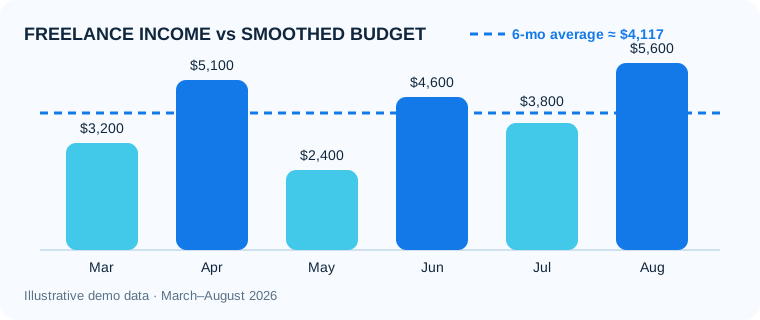
Most budgeting apps assume a salary that lands on the same day each month. Freelancers, contractors, and gig workers live differently: invoices clear late, quiet months follow strong ones, and nobody withholds tax. The trizeflow app is pitched squarely at that reality. Budgets flex around expected income ranges instead of a fixed monthly template, and the forecast view projects the gap between money arriving and bills leaving.
Two ideas stand out for solo earners. The first is income smoothing: a strong month is treated as funding for the weak ones, with a nudge to park the surplus rather than inflate spending. The second is forward visibility. Cash-flow forecasting combined with bill reminders answers the only question that matters before a slow patch — can this expense wait until the next invoice lands? It is the guardrails-over-doctrine approach we favor, close to the cash flow definition in our money glossary.
A sample freelance month, mapped
To pressure-test the pitch, we mapped a plausible March 2026 for a two-client designer through the demo flows: three invoices, uneven payment dates, and a quarterly tax bill looming. The workflow holds together because the app plans from the deposit, not the calendar.
| Bucket | Amount | Share of income |
|---|---|---|
| Income deposited (3 invoices) | $5,100 | 100% |
| Tax set-aside | $1,275 | 25% |
| Fixed bills & subscriptions | $1,140 | 22% |
| Flexible spending | $915 | 18% |
| Groceries & transport | $620 | 12% |
| Buffer carried to next month | $600 | 12% |
| Savings goal: emergency fund | $400 | 8% |
| Equipment sinking fund | $150 | 3% |
| Allocated in the demo plan | $5,100 | 100% |
None of this arithmetic is exotic — a spreadsheet can do it. The difference is upkeep: categorization, the tax set-aside, and the buffer update automatically as transactions import, which is exactly where manual systems for irregular income collapse in month two.
How it stacks up for solo workers
The closest established rival for irregular earners is YNAB, whose assign-every-dollar method handles lumpy income well but demands daily attention and carries one of the higher subscription prices we track. Monarch Money is polished but oriented toward salaried households, and PocketGuard answers “what is left” quickly without forecasting far ahead. Trizeflow finance appears to aim between them: more guidance than a plain tracker, less doctrine than YNAB.
If the launch version matches the demonstration, it will enter our best budgeting apps of 2026 ranking with a real chance at the top three. Until then, our budgeting-app selection guide lists the checks worth running during any free trial — bank coverage, export quality, and cancellation terms included.
Launch timing, pricing, and safety
Release materials point to a shipping version before the year is out, so this review stays in preview until then. Cost is open: expect a usable no-cost level plus a modestly priced upgrade — Jon will check the checkout screen before we update this page. The safety architecture runs one direction: balances and transactions flow in, payment instructions cannot flow out, and records stay encrypted in transit and at rest.
The honest caveats: there is no public track record, sync accuracy is unproven outside the demo, the feature set is still expanding, and we have not tested customer support. Our 4.3/5 is therefore a provisional first-look score, pending a full four-week test after launch.
Frequently asked questions
Is trizeflow good for freelancers with irregular income?
That is the clearest strength on the sheet. Flexible budgets, income smoothing, a forward cash-flow view, and bill nudges all assume paydays that move rather than a fixed salary. The catch is timing: the shipping version lands in the second half of the year, so keep a stopgap tool ready.
How much will trizeflow cost?
Nothing firm has been published on price so far. The hints point to a free starting plan with a single paid tier above it at a moderate rate. Given 2026 paywall habits, check whether bank connections, forecasting, and investment tracking sit behind one before committing to an annual plan.
How risky is a trizeflow bank connection?
The announced setup is reassuring: bank feeds flow through one-directional open-banking channels that cannot push money out, encrypted to banking standards. That reduces risk but never removes it. Use a unique password, enable device security, review permissions, and confirm your bank is supported at launch before linking accounts.